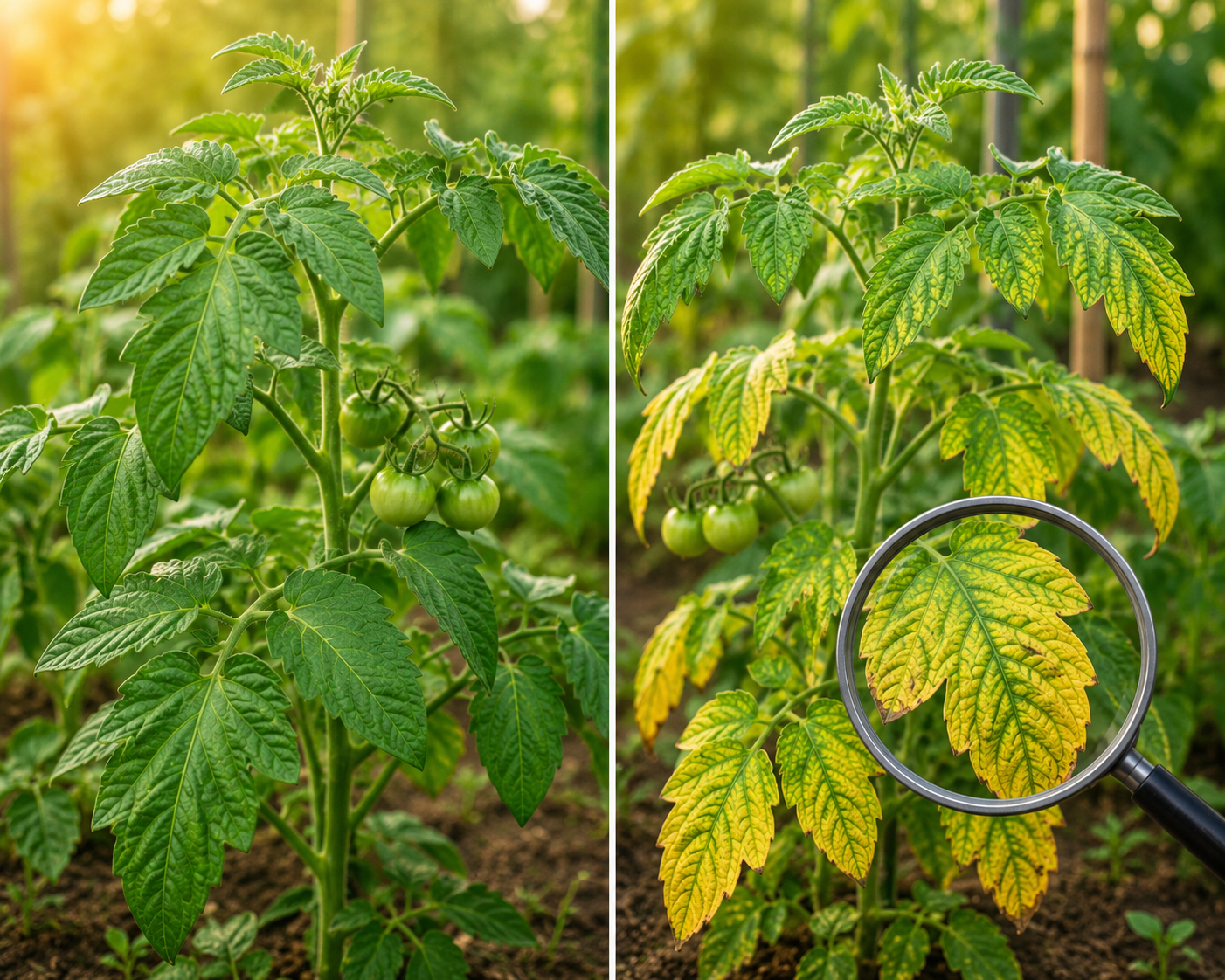
Something is wrong with your plant — it’s always a cause for concern. But before rushing out to buy a treatment, it’s important to understand one simple thing: a plant may look sick not because it’s been attacked by a fungus or virus, but simply because it’s lacking some essential nutrient. And that’s a completely different problem with a different solution.
If you make the wrong “diagnosis”, you’ll waste money and your plant won’t recover.
The first thing to look at — where did the symptom appear?
This is the most important question.
🔸 Symptoms on the lower, older leaves — this is most often a sign of nutrient deficiency. When a plant lacks, for example, magnesium or nitrogen, it does a clever thing: it takes this element from its “old” leaves and sends it to where something new is growing — young leaves, flowers, fruits. The old leaves turn yellow or develop a strange color, while the top of the plant still looks normal.

🔸 Symptoms on young leaves and tops — this is more complicated. Elements like calcium or iron can’t move within the plant at all. Wherever they settle, that’s where they stay. So the new leaves don’t get enough, and they immediately grow poorly — pale, curled, or deformed.
If it’s a disease, though — spots, yellowing, or wilting can appear anywhere, and most importantly — they quickly spread to neighboring plants.

What nutrient deficiency looks like — and what disease looks like
Nutrient deficiency usually appears “tidy”:
▪️ leaves turn yellow evenly, or yellow between the veins, while the veins themselves remain green;
▪️ discoloration is blurred, without sharp edges;
▪️ all plants in a row look the same — the symptom is similar everywhere.
Disease looks different:
▪️ spots have clear edges, often with a dark or yellow border;
▪️ on the underside of the leaf you can see a coating, fuzzy covering, or dots (these are fungal spores);
▪️ spots are scattered chaotically, not symmetrically;
▪️ neighboring plants start getting sick one after another.
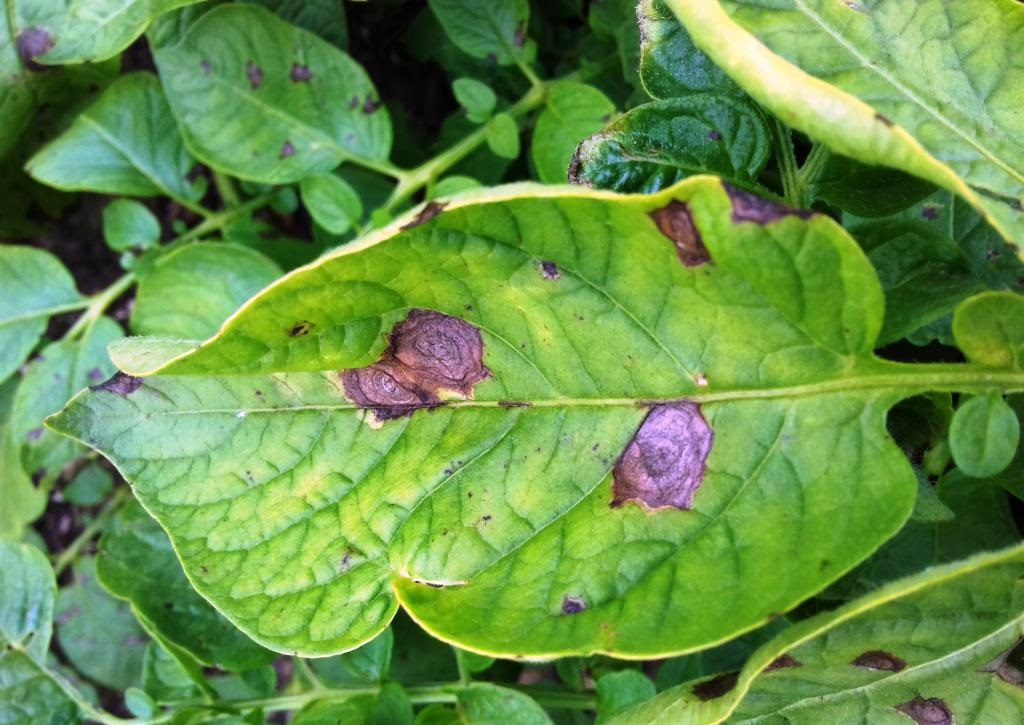
The most common cases where gardeners make mistakes
▶️ Yellow leaves between the veins on tomatoes or grapevines. It looks scary, but it’s almost always a magnesium deficiency. There’s no fungus here — just give magnesium (magnesium sulfate, 1 tsp per 10 L of water, water or spray the leaves).
▶️ Black or brown spot on the bottom of a tomato. Many people think it’s rot or a disease. In fact, it’s blossom end rot — the plant lacks calcium specifically in the fruit. The main reason is usually uneven watering: sometimes too dry, sometimes too much water. No fungicide will help here.
▶️ Young leaves are pale or yellow-green, while old leaves are green. This is classic iron deficiency. It’s treated with iron chelate — available at any garden store.
▶️ Leaves curl into tubes. In hot weather on tomatoes, this is just a protective reaction to the heat — the plant reduces evaporation. It’s not a disease, nothing needs to be done.
Four questions to ask yourself in the garden
When you see something suspicious on a plant — just answer four questions:
✔️ Where did it appear? On the lower old leaves or the upper young ones?
✔️ What does it look like? Even discoloration with no clear boundaries — or distinct spots with a border and coating?
✔️ How quickly does it spread? Stays in one place for weeks — or spreads to new plants in a few days?
✔️ What happened before? Was there a drought or, on the contrary, overwatering? Has it been a long time since you fertilized? Or was everything fine, and then after rain and warmth something appeared?
These four questions will give you the right answer in most cases, even before any tests or purchases.
Plants “talk” to us with their appearance. Just learn to listen to them — and you’ll spend much less unnecessarily.


Comments (0)