A small plot is not a reason to give up on crop rotation. On the contrary, mistakes accumulate faster in limited space: the soil becomes depleted, diseases and pests “settle in,” and the harvest gets weaker year after year. Well-planned crop rotation helps avoid these problems even with just a few beds.
Why Crop Rotation Is Especially Important in a Small Garden
When the same crops grow in the same place every year, they take the same nutrients from the soil and leave behind pathogens typical for them. On a large area, this is partly compensated by space, but in a small plot, the soil quickly becomes “tired.”
Crop rotation allows you to:
▪️reduce the build-up of diseases and pests;
▪️use nutrients more evenly;
▪️improve soil structure;
▪️reduce the need for chemical treatments.
Main Principle: Rotate Families, Not Just Crops
One of the most common mistakes is focusing only on crop names. In reality, it’s important to alternate botanical families, as they share common diseases, pests, and nutrient needs.
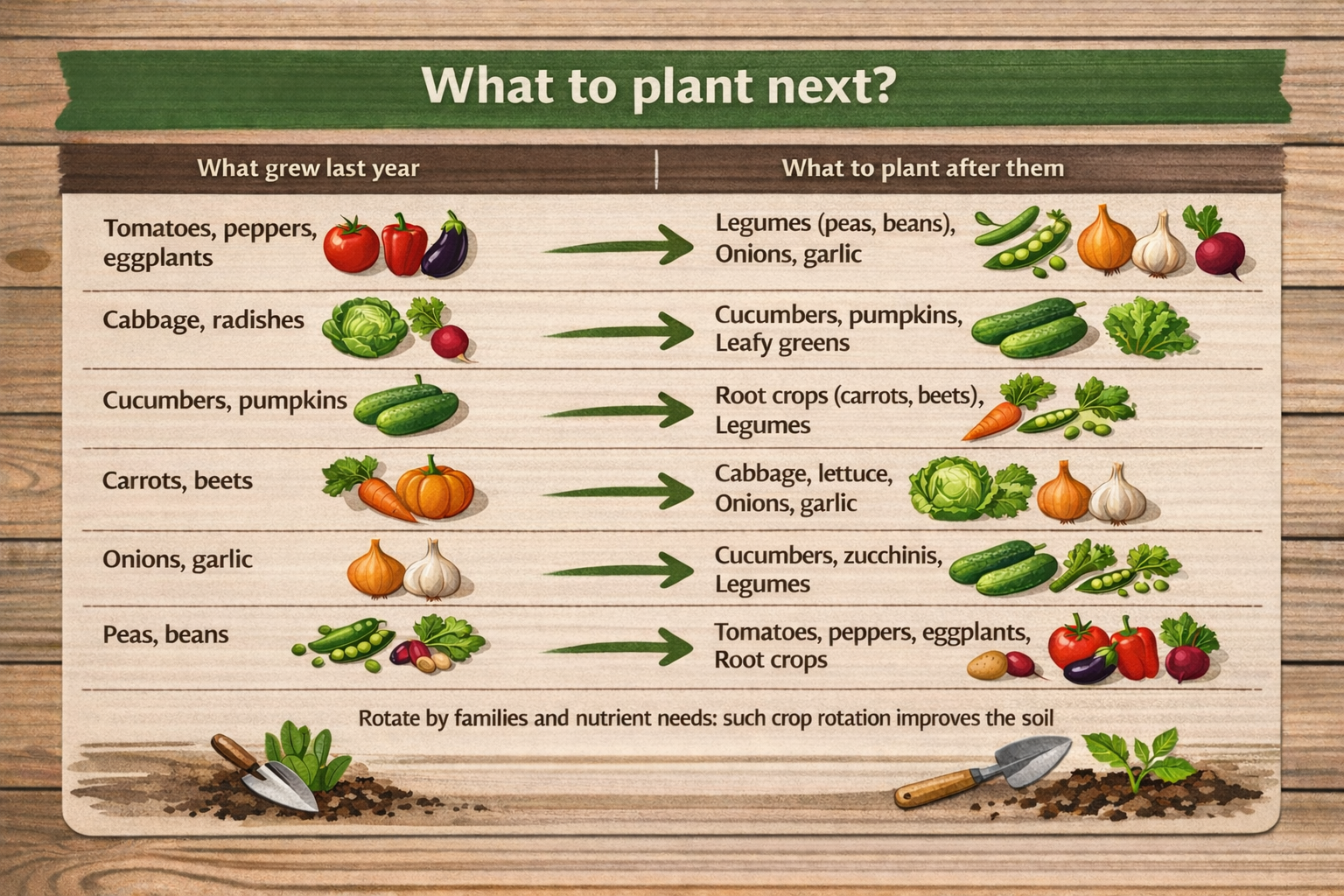
For example, if tomatoes grew in a bed last year, you shouldn’t plant peppers or eggplants there—they belong to the same family. It’s better to replace them with legumes, root crops, or greens.
How to Start Planning: A Simple Algorithm
Begin crop rotation planning on paper or with a diagram. First, draw your plot with the actual beds. Even if there are only 3–4, that’s enough for logical rotation.
Next, recall or write down what grew where last season. Without this step, crop rotation turns into chaos. If you don’t have this information, it’s best to start with a “clean” year and keep records from now on.
Basic Rule for Rotating Crops
For a small plot, a simplified scheme works well, where crops alternate based on their nutrient requirements:
1️⃣Crops with high nutrient needs
2️⃣Crops with moderate needs
3️⃣Undemanding crops or soil improvers
This way, even 3–4 beds can be effectively rotated in a cycle year after year.
What to Do If Space Is Very Limited
On very small plots or home gardens, full crop rotation can sometimes be hard to implement. In such cases, compromise solutions can help:
✔️ partial crop rotation (at least changing the family);
✔️ green manure (cover crops) between main crops;
✔️ active use of mulch;
✔️ mixed plantings where crops complement each other.
Even a small change in the crop on a bed has a positive effect.
Common Mistakes in Planning
Most often, crop rotation doesn’t work due to haste or a formal approach. Gardeners often plant “what’s convenient,” ignoring what was grown before. Another mistake is trying to squeeze too many crops into a small space without considering their needs.
Also, remember that crop rotation is not a one-time solution, but a system for several years ahead.
How to Make Life Easier
To keep crop rotation from becoming a yearly puzzle, keep simple notes: what grew, how the crop felt, what problems there were. Over time, this lets you adjust the scheme for your plot, soil, and climate.
Crop rotation on a small plot isn’t about perfect tables, but about logic and consistency. Even simple rotation of families and crop types significantly improves soil condition and harvest stability. Better an imperfect but well-thought-out crop rotation than none at all 🌱